
The Company Settings allow administrators to establish default behaviours for RAAS, which will apply uniformly across the RAAS application. It includes 14 sections of business rules that a designated company administrator can configure.
Navigation:
Settings > Company Settings
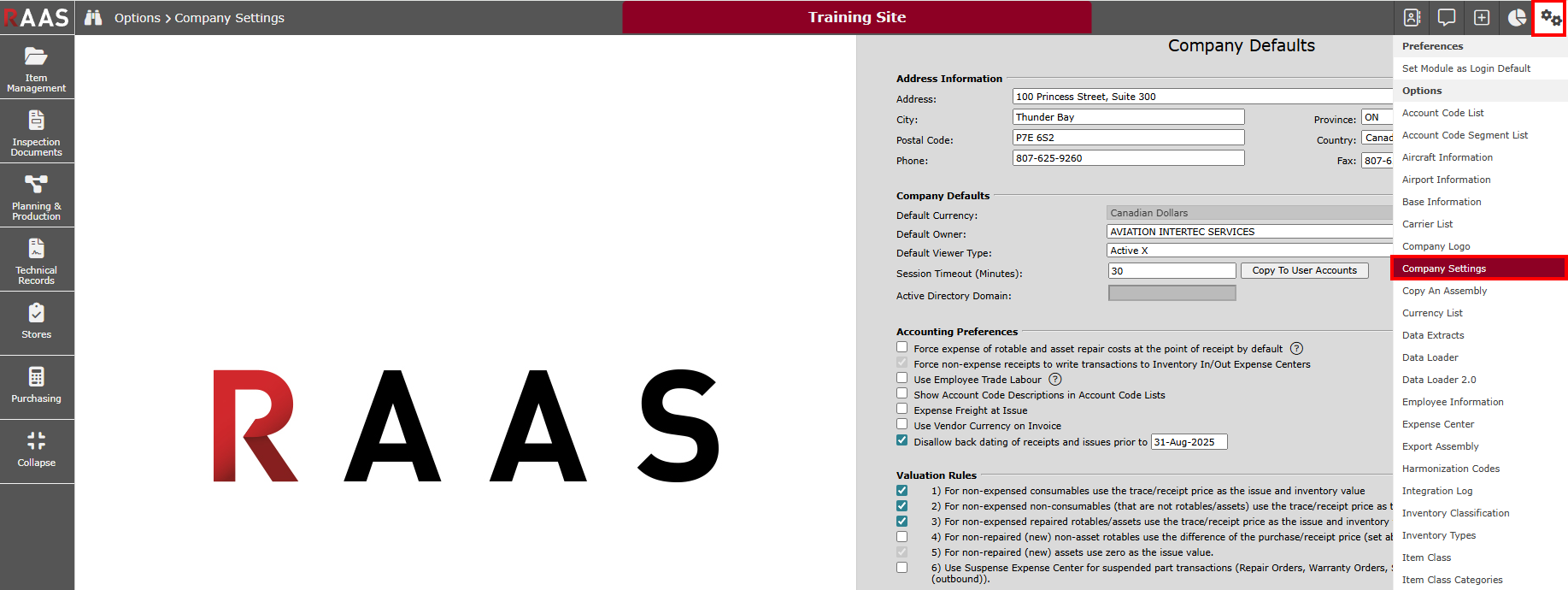
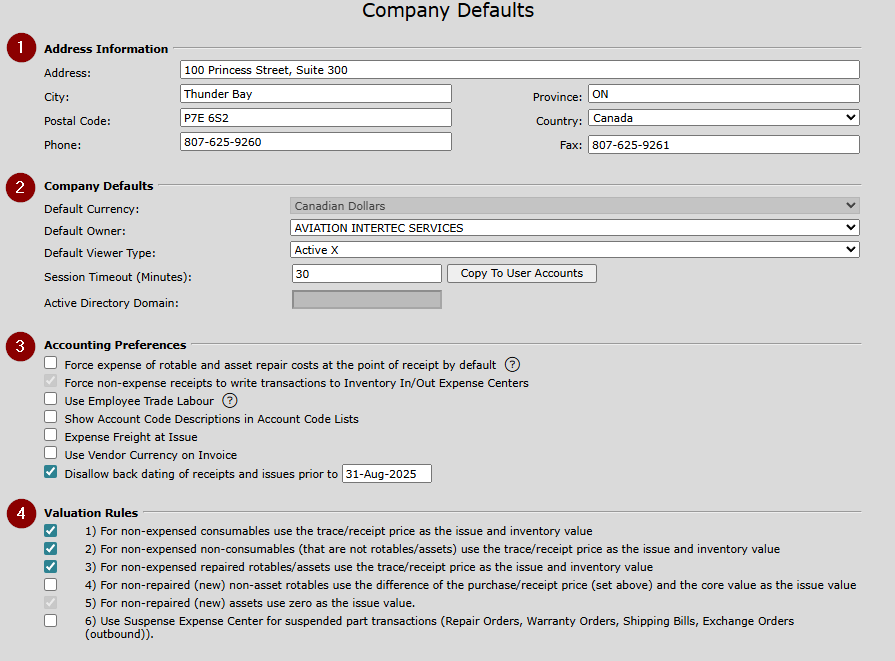
1. Address Information
Appears on numerous reports, such as Shipping Bills, RFQ's, Work Order Invoices and Commercial Invoices.
2. Company Defaults
-
Default Currency
-
set up during implementation as the Company’s Default Currency and is used as the Base Currency for transactions and cannot be edited.
-
-
Default Owner
-
the default owner for all items in RAAS.
-
-
Default Viewer
-
Report Viewer for viewing all reports in RAAS.
-
-
Session Timeout (Minutes)
-
the amount of minutes allowed for a user to be inactive before RAAS logs them out.
-
[Copy To User Accounts] copies the default session timeout to all Users.
-
3. Accounting Preferences
Sets rules for accounting practices, such as forcing the expense of rotables and asset repair costs at the point of receipt.
-
Force expense of rotable and asset repair costs at the point of receipt
-
When this setting is active the "Expense at Receipt" checkbox will be on by default for items applied to orders. It overrides the Expense at Receipt value in the Ordering Rules at the Part Number Level. The receipt value will be expensed to an aircraft. If it sits in inventory, this amount will not add to the inventory value. If cost is expensed, the not yet expensed flag on the Trace will be off.
-
There is an option on Inventory Value Report to show expensed parts as zero value.
-
The Security Role "Purchasing: Bypass expense rotable and asset repair costs at point of receipt" will allow users to toggle the checkbox off even when the setting is active.
-
-
Force non-expense receipts to write transactions to Inventory In/Out Expense Centers
-
Cannot be changed from UI (User Interface).
-
A transaction for the repair cost will be written to the Inventory EC.
-
-
Use Employee Trade Labour
-
When this setting is active labour can be entered per employee in the Planning & Production - Labour Entry module.
-
When this setting is inactive labour can be entered per Job Card from the Trade / Access / Ref tab on the Job Card Detail screen.
-
-
Show Account Code Descriptions in Account Code Lists
-
If this is unselected, anywhere there is an account code dropdown list in RAAS, you will see the account code numbers in the dropdown
-
If this is selected, you will see the account code descriptions in the dropdowns instead of the account code number
-
-
Expense Freight at Issue
-
If there was a freight fee associated with a part received in RAAS, the freight fee would be issued along with the part when it is issued.
-
RAAS users who perform maintenance for customers, the freight charge will appear along with the Part expense center.
-
-
Use Vendor Currency on Invoice
-
Only necessary to select if you are invoicing customers of yours out of RAAS.
-
-
Disallow back dating of receipts and issues prior to (date)
-
Can be used to disallow receipts and issues prior to the date entered when a financial period is closed.
-
4. Valuation Rules
Sets the company-wide for inventory and issue pricing, such as using the trace or receipt price as the issue and inventory value for non-expensed consumables.
-
For non-expensed consumables use the trace/receipt price as the issue and inventory value
-
If this is not selected the average consumable price will be used. The average price can be adjusted from the Pricing window from the SN.
-
This is not commonly used by our customers.
-
-
For non-expensed non-consumables (that are not rotables/assets) use the trace/receipt price as the issue and inventory value
-
If this option is not selected then the Purchase price found in the pricing window from the SN will be used.
-
-
For non-expensed repaired rotables/assets use the trace/receipt price as the issue and inventory value
-
If this option is not selected then the rotable/asset price found in the Pricing window (available from the SN detail window) will be used.
-
-
For non-repaired (new) non-asset rotables use the difference of the purchase/receipt price (set above) and the core value as the issue value
-
If this option is not selected then non-repaired (new) non-asset rotables will be issued using the trace/receipt price.
-
This is not commonly used.
-
-
For non-repaired (new) assets use zero as the issue value.
-
Cannot be changed from UI (User Interface).
-
The reason for this is that it is understood that if something is deemed an asset then the part value will be depreciated outside of RAAS in your finance system.
-
-
Use Suspense Expense Center for suspended part transactions (Repair Orders, Warranty Orders, Shipping Bills, Exchange Orders (outbound)).
-
The purpose of the Suspense Account is to select an EC that the value of the part being sent for repair/exchange temporarily gets moved to.
-
Once the part is received back into RAAS, the amount would be moved from the Suspense EC back to the EC where the part is being received.
-
Default suspense EC can be set for each base on the Base Information page.
-
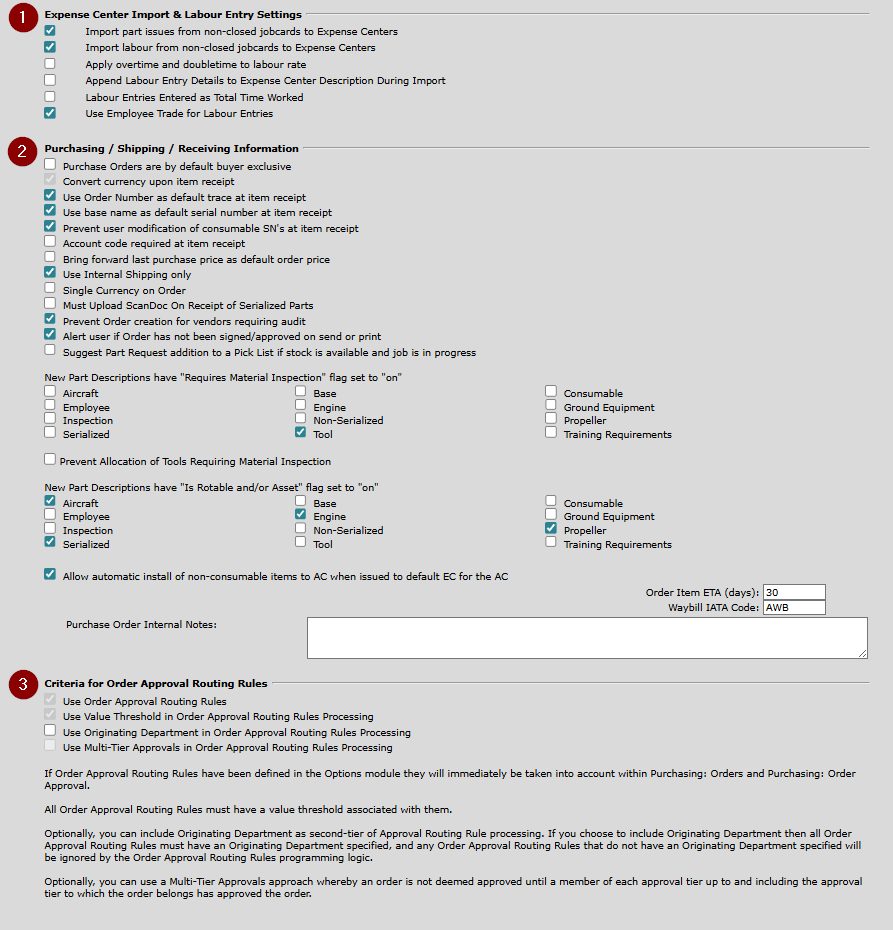
1. Expense Center Import & Labour Entry Settings
Allows for the import of parts and labour from non-closed job cards; Allows users to enter labour either as the total time worked or entries for specific times.
-
Import part issues from non-closed jobcards to Expense Centers
-
-
Import labour from non-closed jobcards to Expense Centers
-
-
Apply overtime and doubletime to labour rate
-
-
Append Labour Entry Details to Expense Center Description During Import
-
-
Labour Entries Entered as Total Time Worked
-
-
Use Employee Trade for Labour Entries
-
2. Purchasing / Shipping / Receiving Information
-
Allows administrator to set the Purchase Order ETA days, which is required for all PO's.
-
Purchase Orders are by default buyer exclusive
-
Convert currency upon item receipt
-
Use Order Number as default trace at item receipt
-
Use base name as default serial number at item receipt
-
Prevent user modification of consumable SN's at item receipt
-
Account code required at item receipt
-
Bring forward last purchase price as default order price
-
Use Internal Shipping only
-
Single Currency on Order
-
Must Upload ScanDoc On Receipt of Serialized Parts
-
Prevent Order creation for vendors requiring audit
-
Alert user if Order has not been signed/approved on send or print
-
Suggest Part Request addition to a Pick List if stock is available and job is in progress
3. Criteria for Order Approval Routing Rules
-
Use Order Approval Routing Rules
-
Use Value Threshold in Order Approval Routing Rules Processing
-
Use Originating Department in Order Approval Routing Rules Processing
-
Use Multi-Tier Approvals in Order Approval Routing Rules Processing
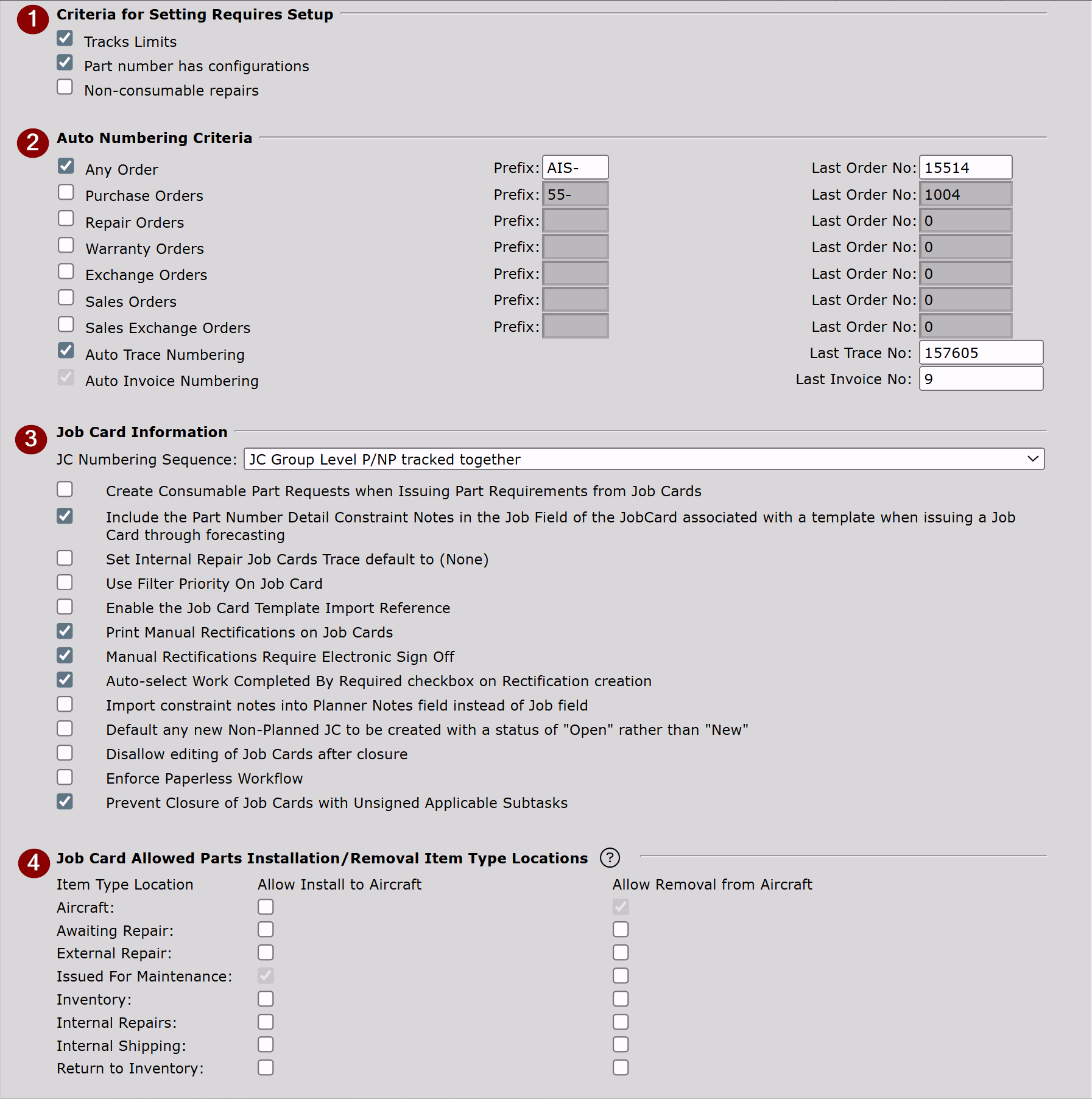
1. Criteria for Setting Requires Setup
Enforces the setup of items at receipt when items have tracked limits or when PN's have configuration or for non-consumable repairs.
-
Tracks Limits
-
Part number has configurations
-
Non-consumable repairs
2. Auto Numbering Criteria
-
Sets the last number for PO, Trace and Invoice, allowing RAAS to auto increment POs, Traces and Invoices.
-
Allows the setup of Prefixes for each Order Type.
3. Job Card Information
Sets the Job Card sequencing and other related job card functions.
-
JC Numbering Sequence:
-
JC Group Level P/NP tracked together
-
Create Consumable Part Requests when Issuing Part Requirements from Job Cards
-
Include the Part Number Detail Constraint Notes in the Job Field of the JobCard associated with a template when issuing a Job Card through forecasting
-
Set Internal Repair Job Cards Trace default to (None)
-
Use Filter Priority On Job Card
-
Enable the Job Card Template Import Reference
-
Print Manual Rectifications on Job Cards
-
Manual Rectifications Require Electronic Sign Off
-
Auto-select Work Completed By Required checkbox on Rectification creation
-
Import constraint notes into Planner Notes field instead of Job field
-
Default any new Non-Planned JC to be created with a status of "Open" rather than "New"
-
Disallow editing of Job Cards after closure
-
Enforce Paperless Workflow
-
Prevent Closure of Job Cards with Unsigned Applicable Subtasks
4. Job Card Allowed Parts Installation/Removal Item Type Locations
-
Indicate allowable installation and removal source locations for Line-Level-Rectifications. Users within Technical Records must still validate installation location as being in Issued for Maintenance or Return to Inventory and removal item location as being installed On-Wing prior to posting a log.
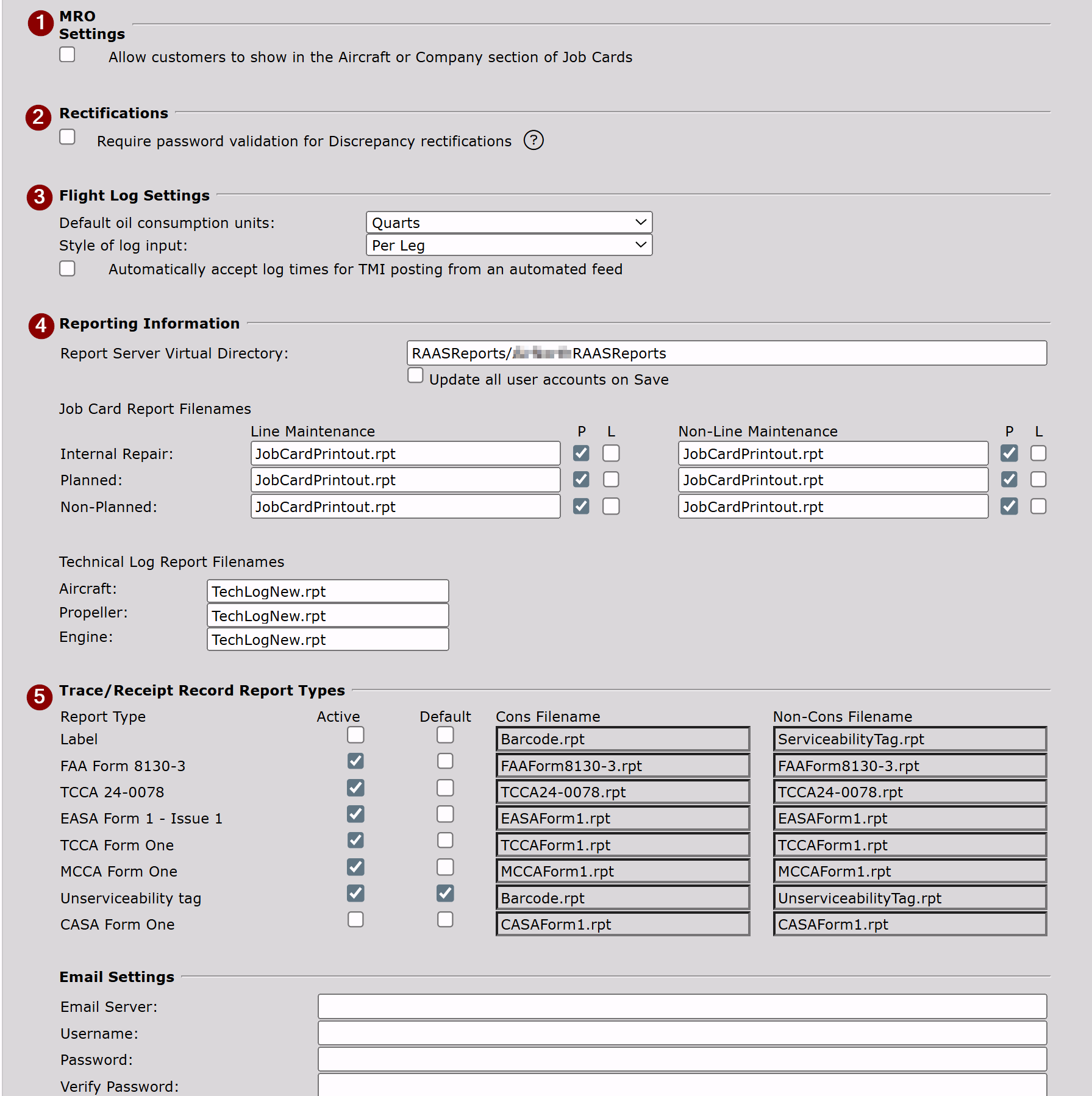
1. MRO Settings
-
Allow customers to show in the Aircraft or Company section of Job Cards
2. Rectifications
-
Require password validation for Discrepancy rectifications
-
When this checkbox is selected, signatures are required for completion of rectifications in the Planning & Production > Discrepancies module. Discrepancies with signed rectifications become available for immediate inclusion in Maintenance Releases, while those without signatures must first be posted in Technical Records > TMI Entry.
-
3. Flight Log Settings
Sets the default units for oil consumption, as well as the log input style.
-
Default oil consumption units:
-
Litres or Quarts
-
-
Style of log input:
-
Per Leg or Per Log
-
-
Automatically accept log times for TMI posting from an automated feed
4. Reporting Information
Sets the Report server virtual directory; custom job card names, as well as the report orientation in order to correctly display job card file attachments.
5. Trace/Receipt Record Report Types
Sets default and active trace reports for both consumable and non-consumable tags.
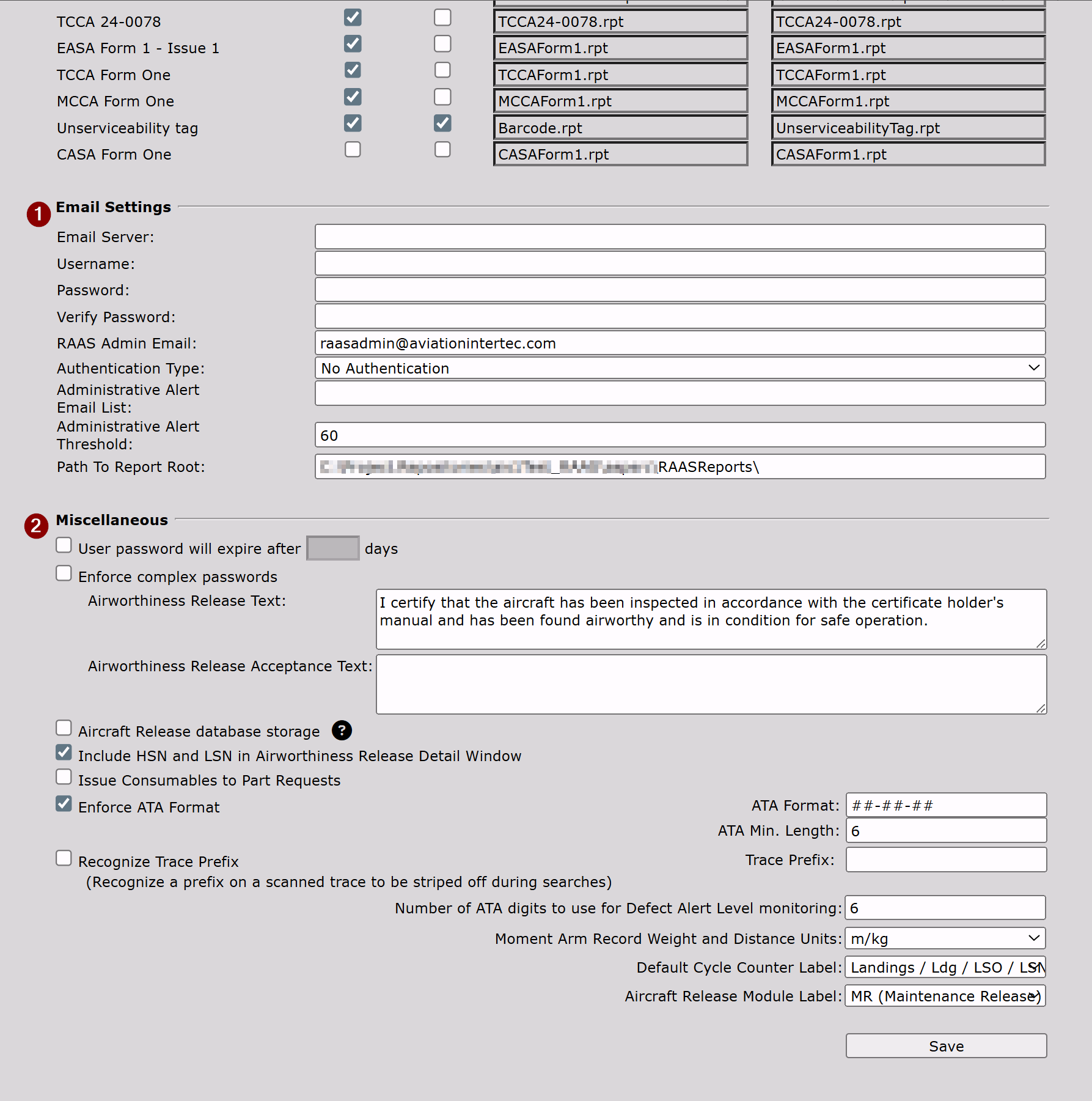
1. Email Settings
-
Required for numerous emailed reports, such as Request For Quotation, Outstanding Job Cards, Deferred Defects and Expired Part List.
-
Except for first time entry, ONLY enter a password if you want to change the existing password
2. Miscellaneous
Set password expiration, force complex passwords, ATA Format, allow issuing of consumables to part requests.
-
User password will expire after ____ days
-
Enforce complex passwords
-
Airworthiness Release Text:
-
Airworthiness Release Acceptance Text:
-
-
Include HSN and LSN in Airworthiness Release Detail Window
-
Issue Consumables to Part Requests
-
Enforce ATA Format
-
ATA Format:
-
ATA Min. Length:
-
-
Recognize Trace Prefix (Recognize a prefix on a scanned trace to be striped off during searches)
-
Trace Prefix:
-
-
Number of ATA digits to use for Defect Alert Level monitoring:
-
Moment Arm Record Weight and Distance Units:
-
ft/lb
-
in/lb
-
m/kg
-
-
Default Cycle Counter Label:
-
Cycles
-
Landings
-
RIN
-
Starts
-
-
Aircraft Release Module Label:
-
MR (Maintenance Release)
-
CRS (Certificate of Release to Service)
-
AWR (Airworthiness Release)
-